
TrustLayer
PDPA compliance you can see, prove and improve.
TrustLayer brings data protection governance, consent tracking and compliance reporting into a single, accountable view, so your teams spend less time chasing spreadsheets and more time improving how personal data is handled.

What is TrustLayer?
Sri Lanka's Personal Data Protection Act, No. 9 of 2022 (PDPA), asks organisations to be deliberate about how they collect, use, share and retain personal data. For most teams that means policies, registers, approvals and evidence spread across departments, systems and spreadsheets.
TrustLayer is a PDPA governance platform designed to streamline that work. It gives data protection owners a central place to organise governance activities, track consent-related processes, assign accountability and produce the reporting that leadership, auditors and regulators expect.
It supports your compliance programme; it does not replace legal advice or the decisions only your organisation can make.
The problems it solves
Most privacy programmes stall for the same practical reasons.
No single view of personal data activities
Processing activities, owners and legal bases live in different documents, so nobody can answer 'what do we hold and why?' quickly.
Consent handled inconsistently
Consent is captured in many channels and tracked differently in each, which makes it hard to show who agreed to what.
Accountability is unclear
Actions arising from reviews or incidents have no clear owner, due date or follow-up.
Reporting takes weeks
Preparing evidence for leadership, auditors or regulators means manually collecting information every time.
What it does
Everything a data protection programme needs to stay organised and demonstrable.
PDPA compliance support
Organise your programme around PDPA obligations with structured governance activities, reviews and actions.
Data protection governance
Maintain registers of processing activities, owners, purposes and retention expectations in one place.
Consent tracking and management
Track consent-related processes and statuses so you can see where consent is relied on and how it is managed.
Centralised visibility
Give data protection leads and management a consolidated view of governance status across teams.
Compliance reporting
Generate clear reports for management, audit and regulator conversations without rebuilding them each time.
Accountability workflows
Assign owners, track actions to completion and keep a record of decisions and approvals.
Audit-ready history
Retain a history of changes and activities so you can explain how you reached a position.
Fits your organisation
Configure structure, roles and terminology to match how your organisation actually works.
Why it matters
Confidence in your compliance posture
See where you stand, what is outstanding and who owns it, instead of relying on memory and scattered files.
Less manual effort
Replace repeated evidence-gathering with reports produced from the information you already maintain.
Stronger accountability
Clear owners and tracked actions make it easier to show diligence internally and externally.
A foundation that scales
A structured programme that grows with new systems, products and business units.
How it is put together
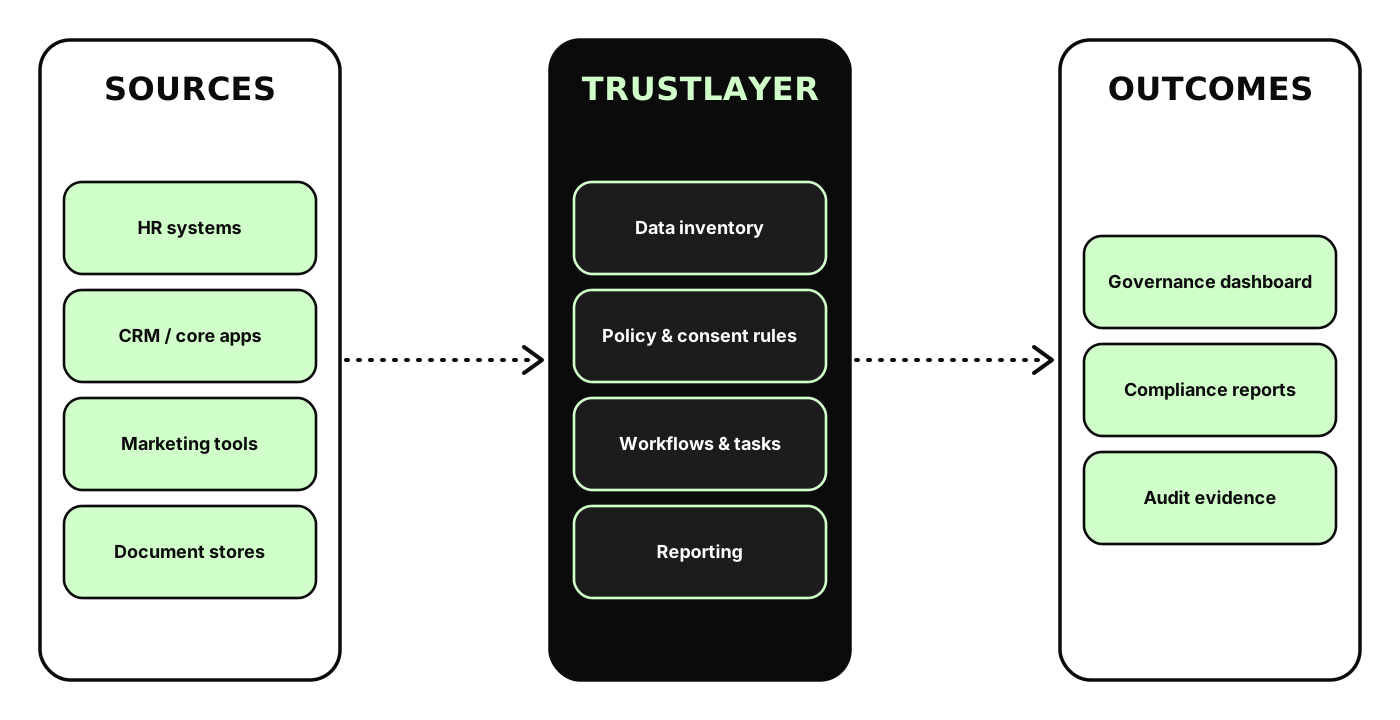
TrustLayer sits alongside your existing systems rather than replacing them. A governance layer organises policies, activities and consent-related records; reporting turns them into evidence.
Data sources and teams
Business owners and systems that process personal data contribute information into the programme.
Governance layer
Registers, policies and activities organised around your PDPA obligations.
Consent and process tracking
Consent-related processes and statuses are recorded and made visible.
Reporting and audit
Information is turned into evidence for management, audit and regulators.
How it works, step by step
From setting up governance to producing evidence, the flow is simple and repeatable.
Set up your programme
Define scope, business units, roles and the PDPA-aligned structure the platform will follow.
Capture processing activities
Business owners record what personal data they handle, why, and how it flows.
Assess and assign actions
Review gaps, raise actions and assign owners with due dates.
Track consent-related processes
Monitor where consent is relied on and how its status is maintained.
Report and improve
Produce reports for stakeholders, then iterate as the business changes.
Where it fits
Building a PDPA programme from scratch
Give a new data protection function a structured way to organise obligations, owners and evidence.
Bringing scattered records together
Consolidate registers and trackers that currently live in different documents and teams.
Preparing for audit and regulator conversations
Produce consistent evidence and a clear history of activities and decisions.
Supporting group and multi-department governance
Provide a consistent approach and consolidated view across business units.
See the experience
Illustrative interface mock-ups that show the kind of views and workflows the product provides.
Built to fit your environment
A governance platform holds sensitive context, so access, accountability and traceability are designed in from the start.
Role-based access
Limit who can view and change governance information to the people who need it.
Audit-ready history
Retain a record of changes and activities for accountability and review.
Data minimisation by design
Hold governance and process information rather than unnecessary copies of personal data.
Aligned with existing systems
Designed to work alongside your current applications, with integration points agreed per engagement.
Companion to VCMP
Pairs naturally with VCMP when you need a dedicated, centralised consent platform.
Reports you can share
Produce reports for stakeholders in formats agreed during implementation.
| Focus | Personal data protection governance and consent-related process tracking |
|---|---|
| Regulatory context | Designed to support organisations working towards Sri Lanka's PDPA (No. 9 of 2022) |
| Access model | Role-based access, configured per organisation |
|---|---|
| Reporting | Management dashboards and compliance reports |
| Implementation | Configured and deployed per engagement, confirmed during discovery |
|---|---|
| Integration | Aligned with your existing systems of record as agreed in scope |

Questions we hear most
Does TrustLayer make us PDPA compliant?
Which law does it support?
How is TrustLayer different from VCMP?
How is it deployed?
How long does implementation take?
Can we see it before deciding?
Often used together

See TrustLayer in your context
Tell us about your environment and we'll show you how TrustLayer would fit, or talk through the options with an engineer.
Descriptions on this page are conceptual. Exact deployment options, integrations and specifications are confirmed with you during discovery.